The Politics of Citizenship in Immigrant Democracies: The Experience of the United States, Canada and Australia by Geoffrey Brahm Levey & Ayelet Shachar
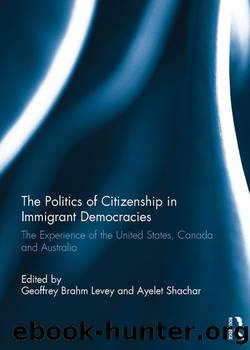
Author:Geoffrey Brahm Levey & Ayelet Shachar [Levey, Geoffrey Brahm & Shachar, Ayelet]
Language: eng
Format: epub
Tags: Political Science, General
ISBN: 9781138886247
Google: FivgoQEACAAJ
Goodreads: 23504316
Publisher: Routledge
Published: 2015-01-15T12:34:25+00:00
Australia is very different to the Australia of the mid-20th century ⦠[but] much is unchanged: our political and legal institutions; our democracy; our liking for freedom, fairness and order; our language and the way we speak it; our love of the beach, the bush and sport. (AMAC 2010, 11; emphasis added)
Second, and at the same time, Australian multiculturalism entertains an open future in which âour evolving national character and identityâ will inevitably reflect the changing composition of the Australian people (OMA 1989, 52; NMAC 1999, 7). There is an acceptance that Australian national identity and culture are works in progress and an expectation that someday, through the culturally diverse backgrounds and everyday interactions of Australians, these things are likely to be very different from what they have been and are today. This dynamic aspect distinguishes Australia from, say, Quebec and many European democracies (and their respective integration regimes), where the dominance of their foundational cultures tends to be considered indelible (Bouchard 2011; Taylor 2012).
For almost 40 years, then, a liberal nationalist architecture as described above has governed Australiaâs approach to liberal democracy and national identity. It has not, however, gone unchallenged. Cultural nationalist sentiment remains strong and even dominant in some institutions. At the popular level, public opinion research consistently finds that a majority of Australians believe that migrants should adopt the Australian way of life rather than maintain their distinct customs (Markus 2011). Outbursts from conservative politicians, such as calling for bans on wearing the hijab or having migrants be instructed to use deodorant, still occur and make headlines, though their proposals typically come to nothing. More significantly, the cultural nationalist legacy continues to be felt in some Australian institutions. This occurs especially in matters involving the symbolic or actual inclusion of minorities in official activities. One example, at the center of Australian democracy, is the persisting custom of opening sessions in both houses of federal Parliament with the Lordâs Prayer despite multicultural lobbying to have the ritual better reflect Australiaâs diversity (Cahill et al. 2004). Another example is the scheduling, in recent times, of national elections and government summits on Jewish religious festivals; such barriers to equal participation were among the very things Australian multiculturalism was supposed to remove. The liberal nationalist âsettlementâ in Australia is thus not yet complete (Levey 2013). It is against this background and these tensions that the two Australian citizenship tests need to be viewed.
Download
This site does not store any files on its server. We only index and link to content provided by other sites. Please contact the content providers to delete copyright contents if any and email us, we'll remove relevant links or contents immediately.
| Anthropology | Archaeology |
| Philosophy | Politics & Government |
| Social Sciences | Sociology |
| Women's Studies |
The Secret History by Donna Tartt(19103)
The Social Justice Warrior Handbook by Lisa De Pasquale(12197)
Thirteen Reasons Why by Jay Asher(8919)
This Is How You Lose Her by Junot Diaz(6894)
Weapons of Math Destruction by Cathy O'Neil(6284)
Zero to One by Peter Thiel(5808)
Beartown by Fredrik Backman(5767)
The Myth of the Strong Leader by Archie Brown(5513)
The Fire Next Time by James Baldwin(5454)
How Democracies Die by Steven Levitsky & Daniel Ziblatt(5225)
Promise Me, Dad by Joe Biden(5157)
Stone's Rules by Roger Stone(5091)
A Higher Loyalty: Truth, Lies, and Leadership by James Comey(4966)
100 Deadly Skills by Clint Emerson(4931)
Rise and Kill First by Ronen Bergman(4797)
Secrecy World by Jake Bernstein(4756)
The David Icke Guide to the Global Conspiracy (and how to end it) by David Icke(4723)
The Farm by Tom Rob Smith(4517)
The Doomsday Machine by Daniel Ellsberg(4493)
